

Russia’s war against Ukraine is increasingly moving beyond conventional military confrontation and transforming into a multidimensional conflict in which critical infrastructure, the environment, and basic living conditions are becoming deliberate targets. The strike on the Dniester Hydropower Plant in March 2026 is a clear example of how war generates transboundary environmental crises with long-term consequences.
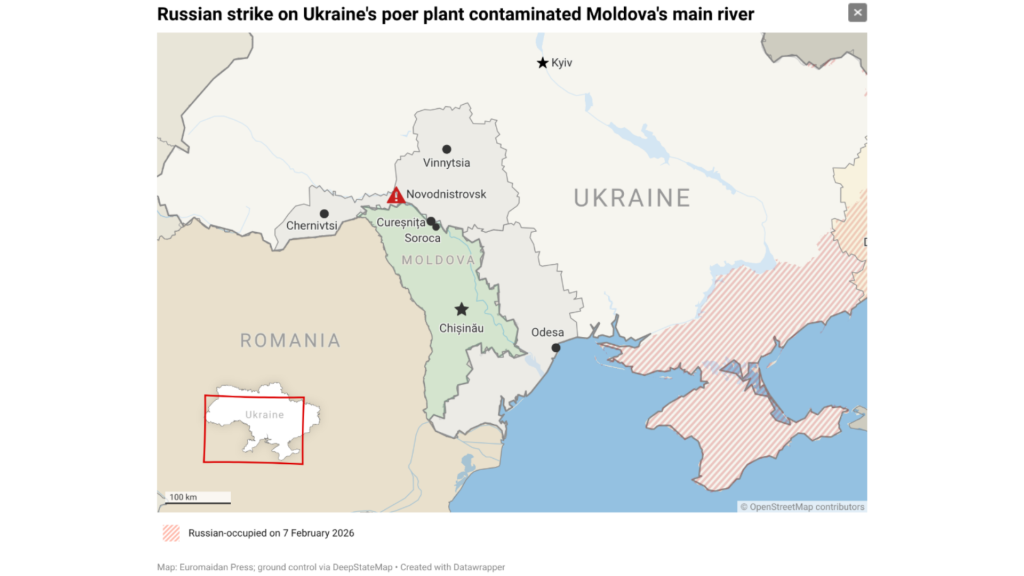
As a result of the attack, energy infrastructure facilities were damaged, causing a spill of transformer oil into the waters of the Dniester River. The pollution began to move downstream, creating an impact that extends far beyond a localized incident. Such attacks are not accidental: attempts to target the same infrastructure were already recorded in 2022, indicating a systematic pattern and strategic intent.
A defining feature of this situation is the transboundary nature of the risk. The Dniester is a critically important water artery not only for Ukraine but also for Moldova, which receives up to 80% of its drinking water from it. This means that any pollution automatically becomes an international issue. In response to rising levels of oil products in the water, Moldova was forced to declare an environmental state of emergency and deploy protective measures to safeguard water intake systems. At the same time, the spread of pollution occurs in waves, significantly complicating forecasting and response efforts.
An attack on a hydropower facility creates multiple layers of risk. First and foremost, it poses a threat of a technological disaster linked to water contamination and ecosystem degradation. At the same time, it creates the risk of losing generating capacity, further destabilizing the energy system. Equally critical is the impact on water security: disruptions in water supply can affect both urban populations and agriculture, while also creating additional public health risks. In a broader sense, this forms a new instrument of geopolitical pressure — environmental destabilization of neighboring states.
The response to the incident demonstrated both the capacity and the limitations of national systems. In Ukraine, measures to contain pollution were rapidly deployed, including the use of containment booms and absorbents, as well as water quality monitoring and coordination between different levels of government. Particular attention was given to protecting water intake systems, including those supplying Odesa. In Moldova, protective barriers were installed near key water intake stations and crisis management mechanisms were activated. However, these actions remain largely reactive and do not address the problem systemically.
The humanitarian dimension of this crisis is equally important. In case of further deterioration, scenarios include supplying water through trucking, distributing bottled water, using filtration systems and purification tablets, and supporting hospitals and collective centers. This means that even without a complete collapse of water supply systems, the region is forced into a mode of humanitarian response. In such conditions, water becomes not only a resource but also a factor of social stability and public trust.
The situation around the Dniester illustrates a deeper transformation in the nature of war. Environmental infrastructure is becoming a target, while natural resources are turning into instruments of influence. This requires a fundamental rethinking of security approaches: the environmental dimension must be integrated into defense policy, civil protection systems, and international cooperation. Crises of this kind cannot be effectively managed at the level of a single state — they require joint response protocols, real-time data exchange, and integrated monitoring systems.
In a broader perspective, the Dniester case may become a precedent for developing new international approaches to defining environmental war crimes and strengthening the role of environmental security within the system of collective security. This is not merely a local incident, but a signal that 21st-century warfare is being waged not only over territory, but also over control of the environment in which people live.